As we move toward the later chapters of Teaching Each Other: Nehinuw Concepts & Indigenous Pedagogy by Goulet and Goulet (2014), I find myself noticing how the teachings shared by Elders in our EDL 829 class continue to echo, deepen, and illuminate the ideas in the text. These past couple of weeks, Elder Helper Roland Key joined us, and his reflections carried forward the threads of lifelong learning, respect, humility, and responsibility that have shaped our past conversations. At the same time, this was echoed in Elder Jim Pratt’s visit and how both Elders’ teachings help tie together the many ideas we’ve explored this semester.
Roland began by reminding us that respect is foundational. He said that while many people have more knowledge or experience than he does, “respect can take you a long way.” His words felt like a grounding point, an affirmation that teaching and learning is not just about marks or mastery but founded in relationship. Goulet and Goulet describe something similar in their discussion of relational pedagogy, emphasizing that learning is sustained through reciprocity, responsibility, and mutual care.
What struck me next was Roland’s humility around knowledge. He told us, “It’s their words, their knowledge. I just echo what they told me. It is not ours to keep, it is ours to share.” This teaching reminded me of the Cree idea of kiskinaumatowin, which Goulet and Goulet explain as learning and teaching as shared endeavour (p. 141). Knowledge is not a possession; it is something carried, tended, and passed on, with the hope that it will resonate with someone else in a way that inspires them to keep the circle moving.
He later added, “We’re on our own cultural path; it’s up to you to find the right road for you.” That idea tied back to Elder Shelly’s teachings on balance and personal adaptation of the medicine wheel. It also reflects the student-centred nature of Indigenous pedagogy—each learner’s path is unique, and the teacher’s role is to support, guide, and walk alongside, not to direct or impose.
Roland also spoke about courage: “The best thing to do is whatever you are afraid to do.” It reminded me that learning, especially the experiential learning described by Goulet and Goulet, in CHAPTER 10, often lives just beyond the edge of comfort. Growth requires stepping into spaces of uncertainty, reflection, and risk.
His final teaching, about the buffalo, offered a powerful metaphor for education:
“The buffalo is going to feed you, put a roof over your head, clothe you… all the things that education is going to do for you. You also need to respect and share.” — Elder Roland Key
Education sustains us, but only if we embrace it with gratitude and reciprocity.
The same thoughts were echoed in the wisdom of Elder Jim Pratt from Muscowpetung, who spoke to our class. Jim brought an important reminder about humour and humanity in teaching. “It is a balancing act; if you’re an old dirty sock on the wall, you won’t have any teaching that students absorb.” I laughed, but his point was legitimate: humour creates connection. It brings teachers down to earth and helps students see us as human beings. This humanizing is itself a form of respect. It opens the door for relational learning, the kind Goulet and Goulet describe as foundational to Indigenous pedagogy when they describe teachers who are able to “laugh at themselves and with students… as a key to positive relationships with Indigenous students” (p.107)
Jim also grounded his teaching in the land through the teepee teachings. He told us about the thirteen pins made from red willow—how the bark, when green, can be mixed with tobacco to make medicines, and how if even one pin is removed, the whole structure falls. His question still lingers with me:
How do we relate to that pin?
Can a teacher serve as a pin that helps hold the learning environment together?
Not as the centrepiece or the authority, but as one essential element in a structure made of relationships, responsibilities, and supports.
This metaphor ties directly to Goulet and Goulet’s emphasis on holistic, community-connected learning. A learning community stands because each part, each person, plays a role.
I saw the living truth of these teachings last week when we brought students from our Indigenous Students Circle to the Saskatchewan School Boards Association (SSBA) meeting. It was one of the most powerful moments of the semester. Our students stood in front of school board trustees and directors from across the province and shared their experiences, hopes, and concerns. They spoke honestly about the supports they need, the barriers they face, and the kinds of relationships that help them thrive.
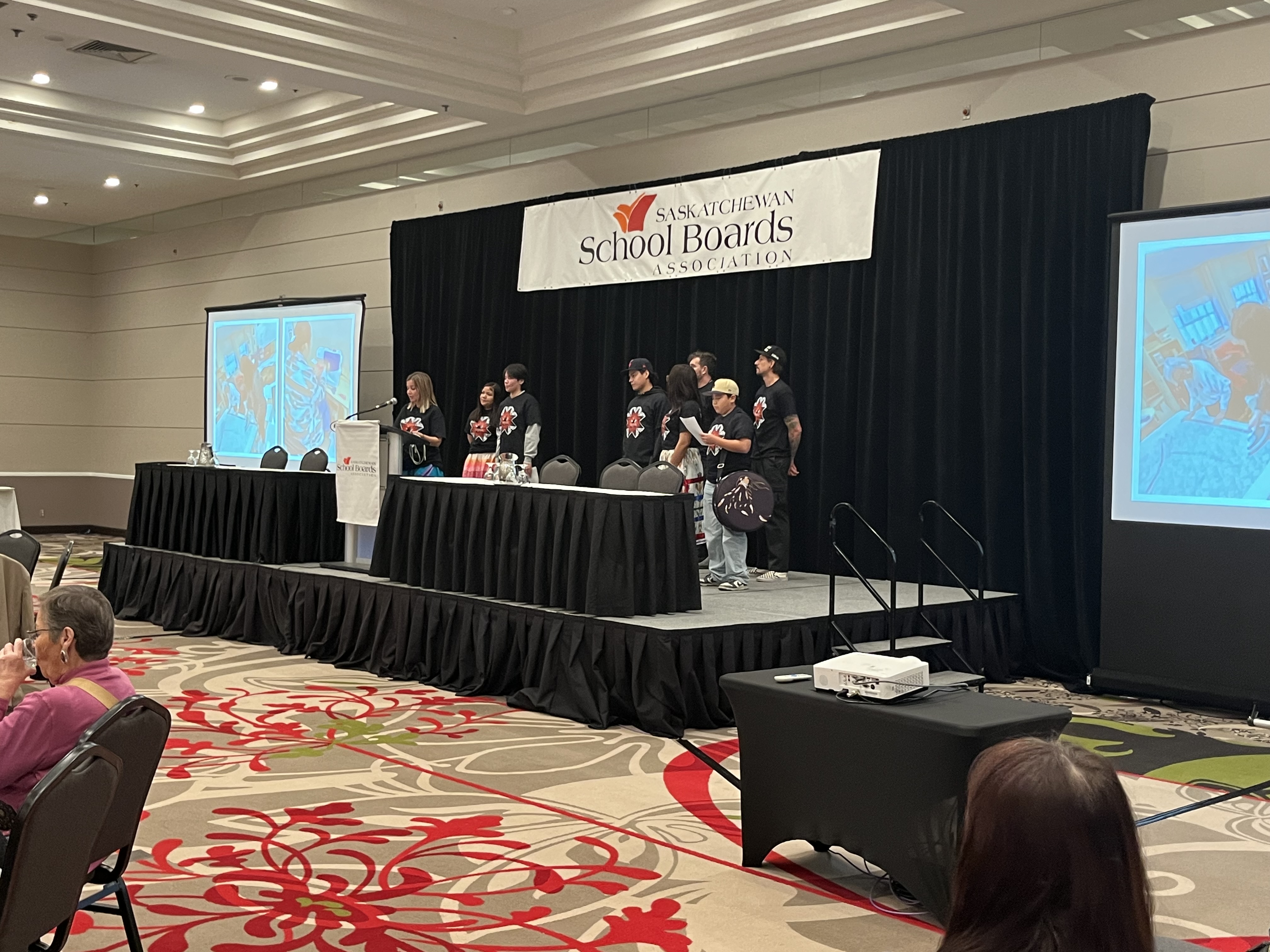
What struck me most was how our role as educators in that moment felt exactly like the “pin” in Elder Jim’s teepee. We didn’t speak for the students, we simply helped create the space where they could stand, be heard, and hold up their own voices. That experience embodied the relational, reciprocal, student-centred pedagogy Goulet and Goulet describe: teaching not as directing, but as facilitating learning that empowers students to speak from their own knowledge and experience.
As I look back over the weeks and my blog posts, I see how all these teachings; humour, respect, humility, balance, courage, sharing, relational responsibility connect and support one another. They form a structure, not unlike the teepee, held together by many pins: the teachings of Elders, the wisdom of communities, the theory in the text, the experiences of students, and the reflections we do together
And as Elder Roland reminded us,
“We’re always learning, right until we take our last breath.”
This kind of lifelong learning is a circle rather than a line, carried by respect, rooted in community, and sustained by relationships.
Key Takeaways
- Respect is foundational to all relationships and learning.
- Knowledge is meant to be shared; teaching is an act of reciprocity.
- Humour humanizes us and strengthens connection in the classroom.
- The teepee teachings remind us that learning communities stand because many people hold them up.
- Student voice is powerful, especially when supported and honoured in authentic spaces.
- Lifelong learning continues “until our last breath,” shaped by courage, humility, and community.
 Will Whitten