This week, I revisited Chapter 7 and Chapter 8 of Teaching Each Other: Nehinuw Concepts & Indigenous Pedagogy. I found myself returning to the idea that teaching and learning are living, relational acts. Goulet and Goulet write about classrooms as communities of belonging where knowledge is built collectively and where the relationships between people, place, and story hold as much weight as curriculum or outcomes. That idea continues to feel especially relevant both in my own classroom and in our EDL 829 sessions.
Chapter 7, for me, brings to mind the word wahkohtowin, or what I was taugh as the Cree concept of kinship and relational accountability. Wahkohtowin remind us that connection is not simply emotional or social; it’s an ethical way of being with others. In education, wahkohtowin shows up in how we greet students, how we share stories, how we notice when someone is struggling, and how we care for the space we share. It’s the quiet work of connection that sustains learning.
Opening in a Good Way
This week’s EDL 829 class began in a good way, guided by Elder Helper Kelly Daniels. His sharing grounded us not just in content, but in relation. Kelly’s stories were layered with humour, reflection, and a kind of generosity that opened space for all of us to settle in as learners together. His words wove together community and care in a way that reminded me of Goulet and Goulet’s description of Indigenous teaching as an act of relational interactions; weechihitowin (helping and supporting each other), weechiyauguneetowin (partnerships), weechiseechigemitowin (alliances), weetutoskemitowin (working together) and kiskinaumatowin (teaching each other)(p.121).
One moment that especially stood out was that one of our classmates had joined with his newborn baby on our Zoom meeting. Kelly’s way of sharing, whether intentional or not, seemed to acknowledge and honour that presence. His connections from the stories to the people on our call made the virtual space feel intimate, human, and warm. It was, in a way, teaching each other in real time—a reminder that learning happens through being present with one another, not apart from our lives.
Goulet and Goulet write that responsive teaching means being well planned, responsive to students, and seeing learning as a shared endeavour (Chapter 7). The Cree word kiskinaumatowin captures this beautifully, it encompasses teaching and learning as something we do together. Kelly’s approach modeled that in real time: he was prepared, yet fully present to who we were as a class that day.
That same principle of connectedness is something I try to nurture in the BAC program. Whether it’s during classes, rehearsals, collaborative creation, or even just daily check-ins, I see how these small acts build relational trust. Each class begins with our daily check-in ; sometimes through intentional and structured reflection, other times through an energy rating or a simple circle of sharing. These small rituals are our version of the talking circle that Goulet and Goulet describe (p. 151). They create a safe and relational space where each student’s voice is heard before we begin our creative work.
Through these practices, we build a foundation of trust that allows us to respond to one another with care. Teaching becomes less about control and more about conversation.
Relational Pedagogy:
In Chapter 8, Goulet and Goulet emphasize that learning through relationships also means creating opportunities for learners to teach one another. This relational learning is prevalent in our EDL 829 course. All of our interactive activities are exactly that. This week that resonated with me when Rhett and Alyssa shared their “weather drawing” practice, a simple yet profound way to express and visualize how each person arrives to the day. In EDL 829, even though we meet virtually, these drawings helped us get to know each other a little, by helping us see the collective “weather” of our group. It’s a method that mirrors what Goulet and Goulet discuss in the text where teaching emerges from interaction and shared meaning-making rather than static delivery.
This way of learning is deeply familiar in theatre education. In the BAC drama classes, students devise, perform, and respond to one another’s work in ways that embody these principles. Each rehearsal becomes a microcosm of wahkohtowin: an space of mutual respect, listening, and creative interdependence.
As I reflect on both the readings and the week’s experiences, I’m reminded that our classrooms, whether physical or digital, are always in the process of becoming. Elder Kelly’s stories, Rhett and Alyssa’s weather drawings, and my own classroom check-ins all work toward the same purpose: making learning relational, visible, and shared.
I’m also reflective of how, what Goulet and Goulet describe as “community-based learning” (p. 153), can take place in a school outside of a traditional classroom setting. I have reflected a lot on what I do in terms of classroom practice to support students using the theories and knowledge shared in the the Goulet and Goulet text but I have also recognized how learning and connection can exist in the context of school but outside of the classroom. Last year as part of my work as a learning leader and with the help of other teachers in our school including my dear friend Deanna, our Indigenous Advocate, we formed an Indigenous Students Circle — a group of students that meet twice a month with Deanna, our Knowledge Keeper Rawd, myself and two other colleagues. This group was initially formed to support the work of our TRC committee, however as a Following Their Voices school we decided we should do just that and listen to the voices of the students in regards to what they wanted to do and/see as we worked towards reconciliation and decolonization in our school. What started as a small group of student leaders guiding some of our choices, soon lead to a full school sharing and celebration of Powwow where students emceed, danced and shared information about Powwow. It was an amazing day lead by their voice and choice. This exactly what I envision when Goulet and Goulet discussconnecting to the process in combination with the importance of student belief in self. This belief in self manifests through two ideas: setting standards for achievement and responsibility (p. 154), and valuing self and one’s culture (p. 155).
This event certainly demonstrated what could be done by students when we allowed them to set their own standards for achievement and responsibility and how they demonstrated, not only to our small group but to the whole school (and our Superintendent and Director of Education), what valuing self and one’s culture could look like in our school.
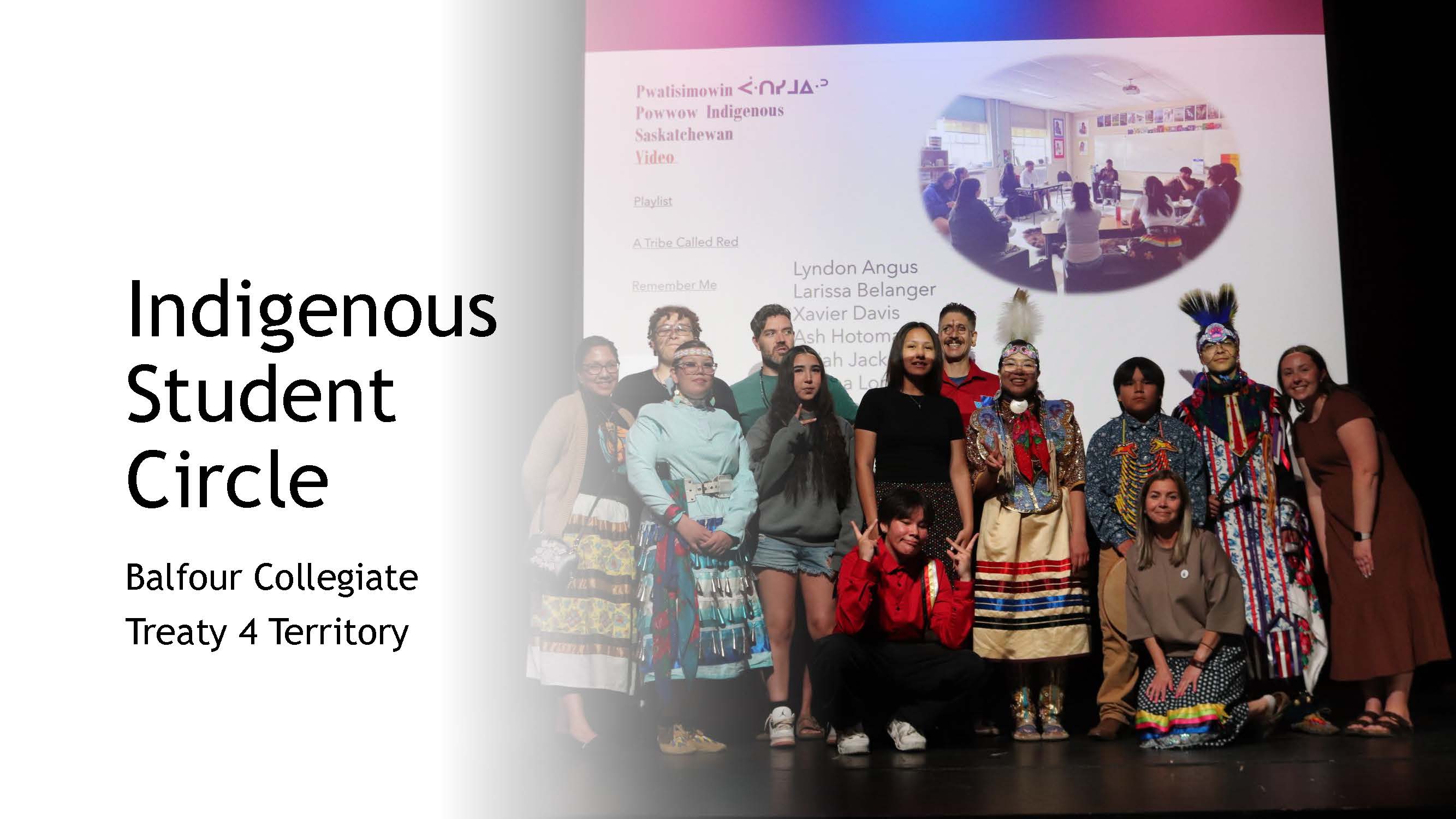
This work continues with this group. Students who join our circle often begin the year hesitant, shy, and often come from a school where they may not have been supported or engaged. But over time (through collaboration; through connection to each other; through connection to our school’s knowledge keeper and Indigenous advocate and through connection to community) they begin to see themselves differently. They take ownership of not just their cultural identities but their holistic sense of self, not because we tell them they’re capable, but because the community and the Student Circle reflects that back to them.
Key Takeaways from Chapter 7:
- Responsive Teaching: Be well planned, adaptable, and view learning as shared (kiskinaumatowin).
- Accommodating Characteristics: Teach with cultural awareness, anti-racist intention, and sensitivity to students’ lived realities.
- Structuring for Success: Scaffold learning through safety, motivation, and strength-based design.
- Student Belief in Self: Cultivate self-worth, responsibility, and cultural pride as core outcomes of education.
 Will Whitten